The energy transition is not only about solar panels, wind turbines, and batteries. Perhaps even more important is cooperation between people and businesses. Across the Netherlands, farmers are generating increasing amounts of renewable energy. At the same time, many businesses are looking for affordable and reliable green energy. Yet these two groups do not always find each other. As a result, renewable electricity often travels a long way through the power grid, even though supply and demand may be only a few kilometres apart.
As part of the European CIRCUS project, ZLTO is therefore working on local energy communities. The goal is simple: to bring producers and users of renewable energy closer together. A strong example is the Roosendaal Energy Trading Platform, where farmers and businesses collaborate on a local energy system.
Insight first, collaboration second
Every region has its own energy story.
Some areas generate large amounts of solar power,
while elsewhere businesses consume substantial amounts of electricity.
To make these opportunities visible, ZLTO prepares a local energy profile.
Such an energy profile maps how much renewable energy is generated,
how much energy businesses use, and at what times of day.
We analyse where surpluses and shortages arise and identify parties
that can strengthen one another. These insights open a conversation between entrepreneurs who often do not yet know each other but are part of the same local energy system. Developing group profiles and analysing generation and consumption patterns provides an important foundation for building local energy communities.
This provides insight not only into the technical possibilities,
but also into the economic and social opportunities created by collaboration.
1. Energy sharing: a new business model for solar power
Many farmers have invested in solar panels in recent years. However, changing energy markets, negative electricity prices, and the phase-out of incentive schemes are putting the business case under pressure.
Local energy sharing offers a solution. Instead of selling electricity directly to the energy market, producers can supply it to businesses in the region. Those businesses gain access to locally generated green electricity, while the producer receives more stable compensation.
In Roosendaal, this takes place through the Energy Trading Platform. Every fifteen minutes, the platform compares how much electricity is being generated locally with
how much energy businesses need at that moment. The better supply and demand are matched, the more renewable energy can be used locally. This keeps more value within the region and makes both parties less dependent on fluctuations in the energy market. The platform was specifically developed to connect local producers with an energy surplus to businesses with energy demand.
For farmers, this means that investments in renewable energy can remain attractive in the long term. For businesses, it offers greater certainty about the source and price of their energy.
2. Working together to reduce grid congestion
By now, almost everyone has heard of grid congestion. In many parts of the Netherlands, the electricity grid is at full capacity. New connections take longer, and businesses are
not always able to expand or make their operations more sustainable.
It is often assumed that the solution lies solely with grid operators.
But local collaboration can also make an important contribution.
When renewable energy is generated and used locally, less electricity needs to be transported over long distances through the grid. This reduces the load on both the regional and national electricity networks. The Roosendaal Energy Trading Platform therefore focuses explicitly on improving the balance between local generation and local demand. Matching generation and consumption locally reduces peaks in electricity demand and feed-in, thereby helping to limit congestion.
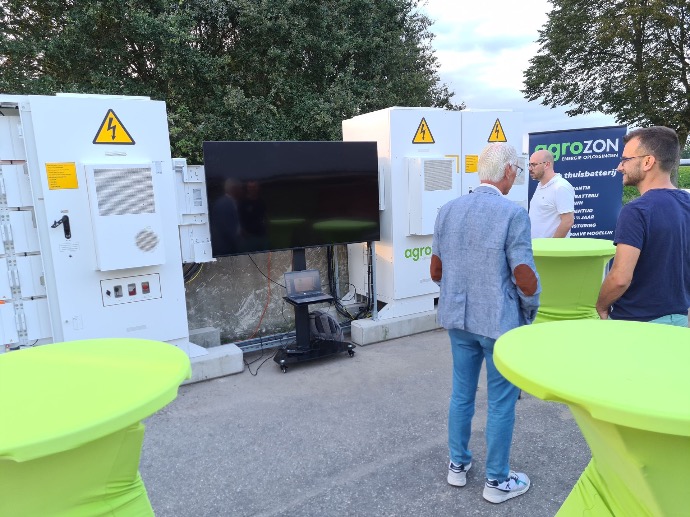
Batteries are playing an increasingly important role in this. Surplus solar power can be stored temporarily and used later when demand is higher. This creates greater flexibility in the energy system.
Within the Roosendaal energy community, work is under way on a collective battery concept in which batteries will be installed at multiple locations. These batteries ensure that locally generated energy remains available to entrepreneurs in the region for longer. They can also contribute to grid balancing and other energy services. This can significantly increase the share of locally generated energy that is also consumed locally.
The result is a smarter energy system with lower peak loads, fewer transmission losses, and more capacity for further sustainability improvements.
3. The power of local connections
The benefits of an energy community are not only technical or financial. Perhaps the most important outcome is the connection it creates between entrepreneurs.
Farmers and businesses often have more in common than they realise. Both want to run successful enterprises, become more sustainable, and secure their future. Yet they do not naturally come into contact with one another. Working together on energy projects creates new relationships and new forms of collaboration.
A farmer who generates renewable electricity gets to know the entrepreneur who uses it. In turn, businesses gain a better understanding of the contribution agriculture makes to the energy transition. This builds mutual understanding and appreciation.
This also affects the sector's public image. Agriculture is becoming increasingly visible
as a provider of solutions to societal challenges, not only as a supplier of food, but also
as a producer of renewable energy, flexibility, and innovative energy-supply solutions.
Within CIRCUS, the agricultural sector is therefore regarded as an important producer and supplier of affordable, reliable renewable energy.
Energy communities also create more local ownership. Entrepreneurs feel that,
by working together, they can influence their own energy supply rather than depending on developments over which they have little control.
Building tomorrow's energy system together
The energy transition requires more than technology alone. It requires collaboration. By preparing local energy profiles, ZLTO brings entrepreneurs together and reveals opportunities for energy sharing, flexibility, and collective investment.
The Roosendaal Energy Trading Platform demonstrates that local collaboration works in practice. Farmers and businesses reinforce one another by exchanging renewable energy, developing joint solutions to grid congestion, and investing in a future-proof energy system. With dozens of participating businesses and farmers, the platform has become an inspiring example for other regions.
Step by step, this is creating an energy system in which renewable energy is not only generated locally, but also used locally. Good for entrepreneurs, good for the electricity grid, and good for the region.