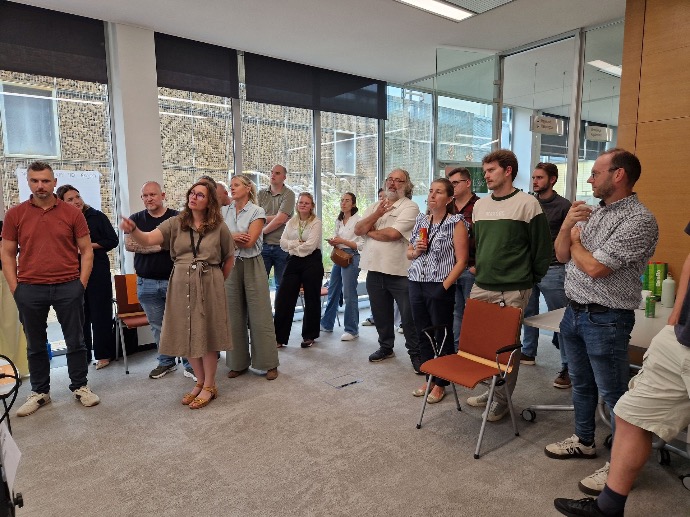
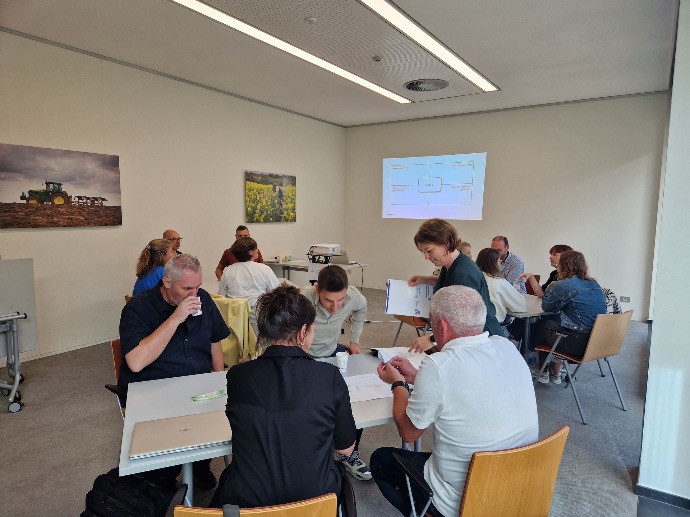
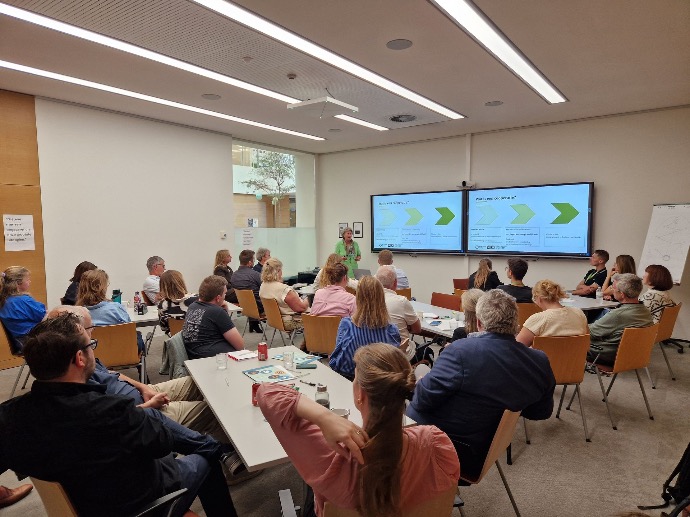
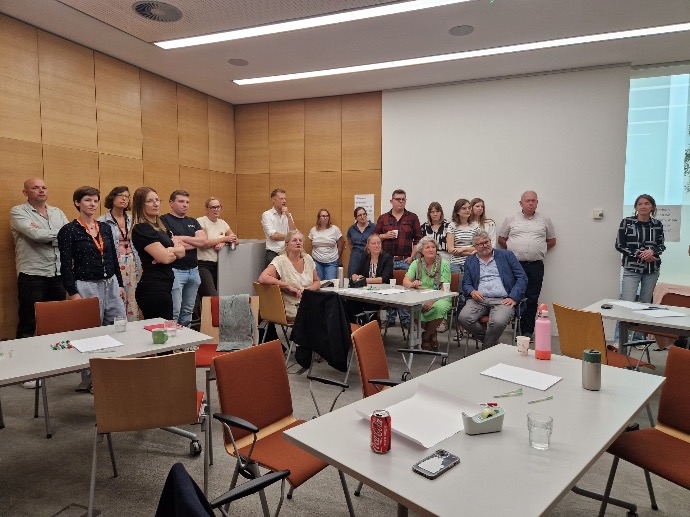
Collaboration can turn promising ideas into practical solutions for agriculture and rural communities. This was a central theme at the Atrium Contact Day, which brought together colleagues from Boerenbond and Landelijke Gilden to explore innovation and the support needed to help new ideas grow.
Marc Van Meldert and Fien Van Esch shared insights from their work, alongside
Anne-Marie Vangeenberghe. Their message was clear: when an idea exceeds what
one person or organisation can achieve alone, working together can help turn it
into a workable plan.
Innovation means adapting
and looking ahead
Innovation can begin with an opportunity,
such as a new way to stand out. It can also be a response to change.
In both cases, innovation means doing things differently,
whether that involves adopting new technology, exploring another business model
or adjusting to changing needs.
The presentation placed today’s choices in a longer perspective.
Farming has changed from hand milking to milking machines and robots.
How people buy, prepare and preserve food has changed too. These examples show that change can happen quickly, so preparing for what comes next matters.
The challenges ahead are wide-ranging.
Rural communities will need to consider mobility, housing, education,
energy and water. Land- and horticulture businesses will also need to respond
to climate change, new crops, affordable energy, data use, precision farming
and changing markets.
Why collaboration matters
Some opportunities are difficult to pursue alone. A business may need more knowledge, investment or production volume than one farmer can provide. Buyers may also prefer to work with one reliable partner rather than coordinate orders and deliveries with many individual suppliers.
Collaboration can help address these barriers. Businesses can work together on purchasing, sales, processing, training, staffing or innovation. The right approach depends on what the partners want to achieve and which parts of their operations they want to share.
Cooperatives offer one way to organise that work. Members are connected as users
and owners, with a role in the organisation’s governance. This shared structure can help a group pursue common economic, social or cultural goals while building a business together.
From an idea to
a group effort
A collaboration needs more than a promising idea. Partners first need to define what they want to do together and where they are getting stuck individually. They should discuss what they expect from one another, what risks they see and what each partner can contribute.
From there, a group can agree on practical rules. These may cover who can join, how quality is maintained, how decisions are made, how income is shared and how a member can leave. Once the shared purpose and working arrangements are clear, the group can consider which legal form best suits its plans.
Professional advice is an important part of this process. The most suitable structure depends on factors such as responsibility, governance, taxation and the group’s goals. Getting advice early can help partners make informed choices before the collaboration becomes more complex.
CIRCUS: connecting rural communities around energy
The session also introduced CIRCUS, short for Connecting Initiatives for Rural Communities: Upscaling their Sustainable Energy. The project supports rural residents, businesses and local authorities as they explore energy efficiency, local energy production and energy communities.
CIRCUS brings together tools and knowledge to help communities understand their energy use and opportunities. These include energy profiling, mapping local potential, assessing business and financial feasibility, and preparing for conversations with local policymakers. The project also aims to train 150 CIRCUS ambassadors who can help share knowledge in their communities.
Two examples showed how collaboration can take different forms. In Ranst, a planned group purchase is intended to make plug-in solar panels and a plug-in battery more accessible, including for renters and households affected by energy poverty. The initiative illustrates how a community can explore a shared response to local energy needs.
FarmPower shows another path. Founded by and for farmers, the cooperative has grown from bringing members together around energy contracts into a platform for knowledge exchange and energy-related services. Its experience highlights how cooperation can help farmers explore opportunities that may be harder to tackle individually.
Putting cooperation
into practice
The examples from CIRCUS show that collaboration is not just a structure on paper. It is a way to bring together people, knowledge and resources around a shared challenge. When partners understand their common goal and make clear agreements, they can test ideas, learn from one another and build solutions with greater reach.
That was the central takeaway from the Atrium Contact Day: innovation does not always start with doing more alone. Sometimes it starts by recognising what is difficult to achieve individually and finding the right partners to move forward together.
Boerenbond supports agricultural entrepreneurs who want to explore collaboration, from inspiration and training to advice and guidance.