In The Netherlands many municipalities have a challenge to house (Ukranian) refugees as a result of net congestion. It takes about 18 months from planning to building pre-fabricated houses, but to connect these houses to the grid may take 2 years longer (1) (2), if at all (3). As a result our municipality (Lochem) asked the LochemEnergie cooperative for a solution.
The project at hand concerns a complex of 35 all-electric houses specifically built for the reception of refugees. Each house is equipped with 3 PV-panels (1200Wp), and a heat pump (4kW). It is a temporary solution as the houses will be physically removed after 10 years. All these attributes are important for the possible solution as we will point out.
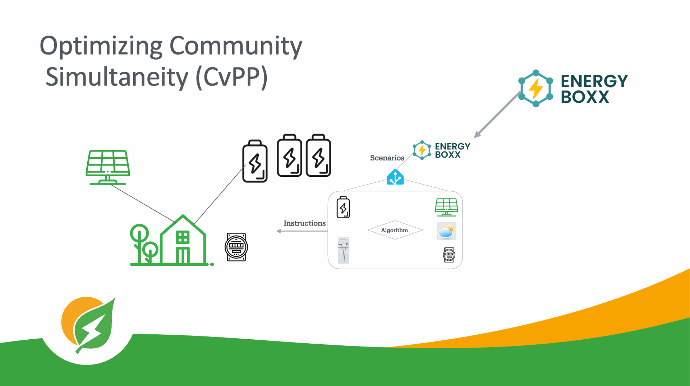
Our solution originates in the idea of energy sharing. Where this normally is only an administrative, or virtual, way of energy sharing, we are now asked to also organize this in a physical way, because the DSO can only deliver 1 mains connection. The solution will thus need a set up of a secondary distribution behind the mains connection to the 35 houses.
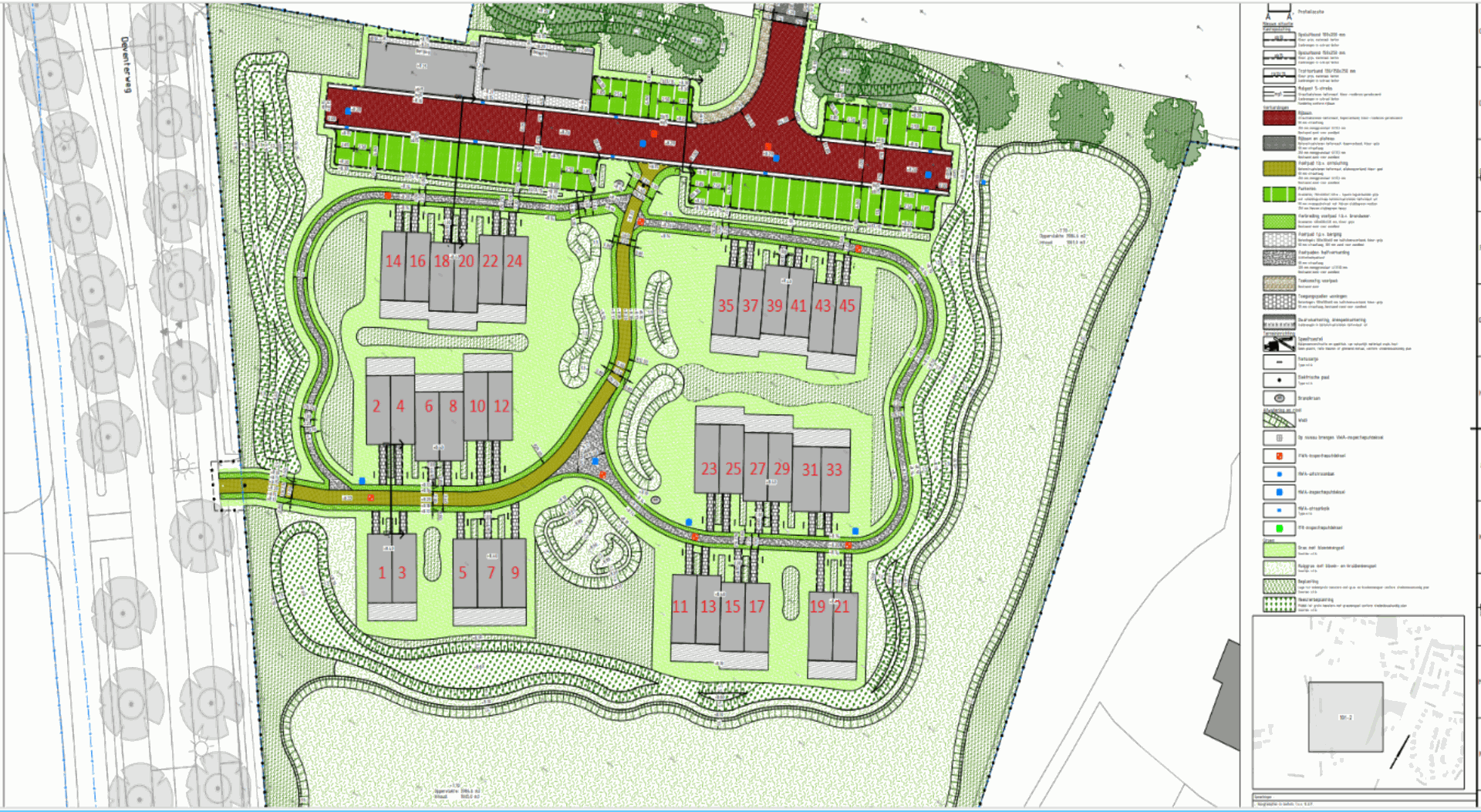
We started by modeling the energy consumption based on the heat-loss
and installed electrical equipment. This theoretical model lead to a solution
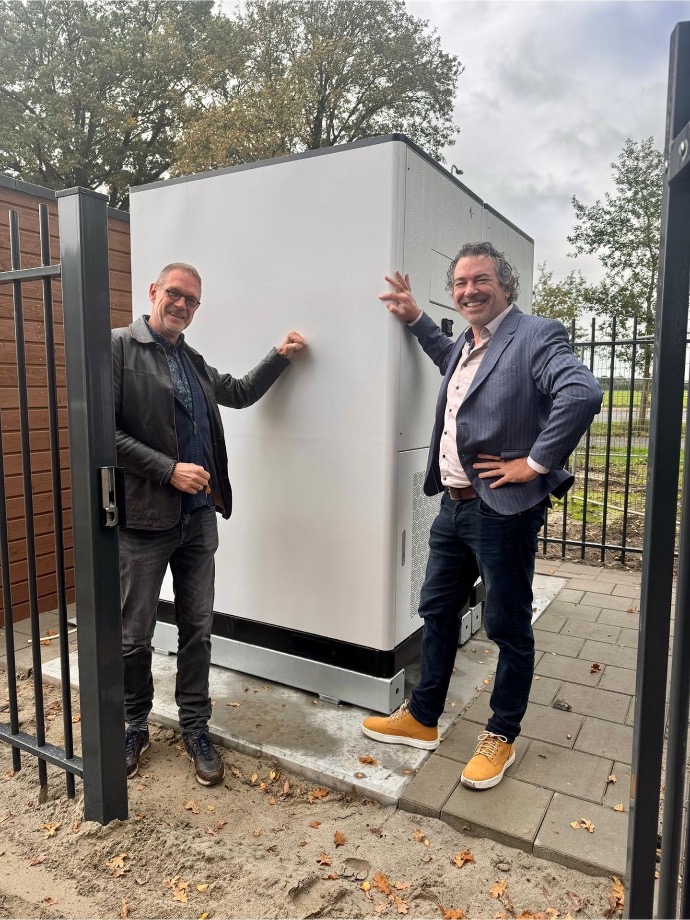
comprising 1 mains connection of 3*80A (230V) and one 430kWh (200kW
or 87A at 230V) battery for peak-consumption. The mains connection of 3*80A is
the largest possible standard household connection (kleinverbruik aansluiting)
in The Netherlands. Normally these houses are individually equipped
with a 3*25A mains connection. This solution lead to an administrative
capacity reduction of approximately 90%. Only as a result of the temporary nature
of this complex and the nature of the residents did the DSO give us permission
for a secondary grid behind the mains connection.
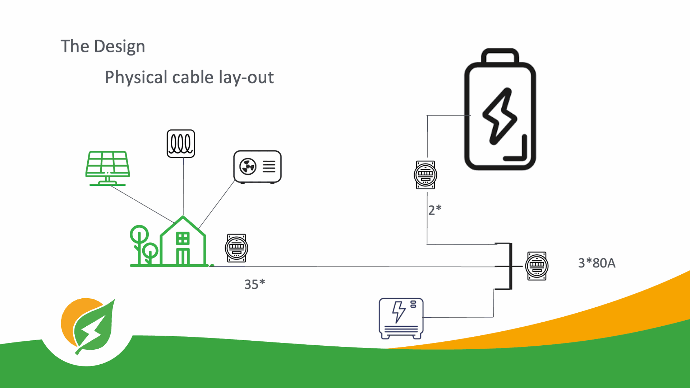
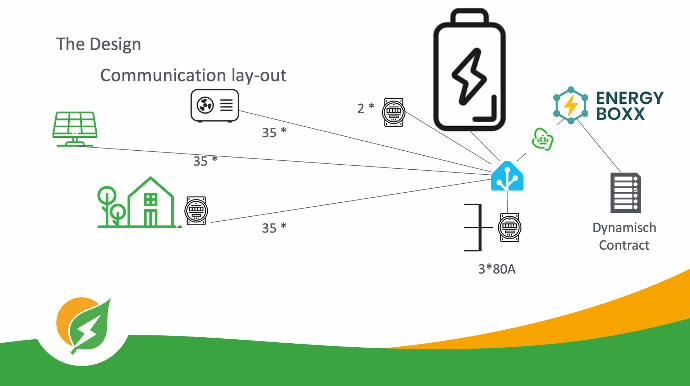
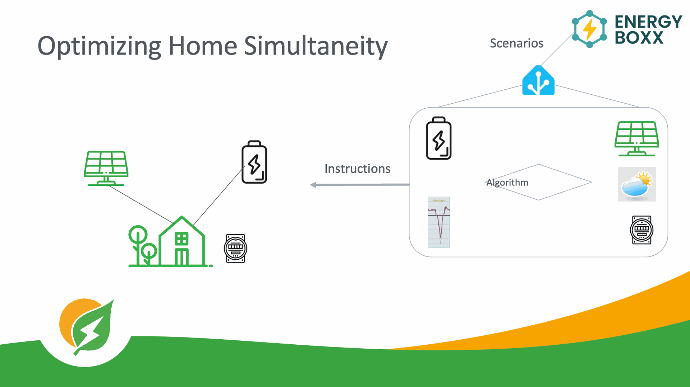
The physical load on the electricity grid of the individual houses is, of course, also influenced. In order to make this solution work within the limited possibilities of 1 mains and the installed battery, it is necessary to install domotica. It is necessary to be able to:
- Determine when and with which capacity the battery will discharge and charge, based on expected demand of the houses in combination with the very limited capacity of the mains connection, market tariffs and predicted outside temperatures.
- Determine if and with which capacity to curtail the PV-panels, based on SoC of the battery, tariffs and predicted sun-hours.
- Determine whether to shut down heat pumps (within temperature deviations of +/-0,5ºC to limit comfort loss) to prevent overloading the mains connection.
However, even with all these technical solutions in place it is as, or even more, important to take into consideration human behavior. Technical modeling of electric consumption of the houses can be overruled by human behavior. And this is precisely what happened and lead to 5 black-outs in the first month of operation.
Investigating the numbers and figuring out at which moments the overloads occurred were one part of the solution into which we will delve in another article. But some figures were so far off the theoretical model that we needed to speak to the residents and visit the houses to find the causes.
Although one of the measures we took was an information brochure and introduction session for the refugee-coaches on the energy setup of the complex, when we spoke to the residents we learned that they were not informed about the very limited nature of their grid connection by their coaches. When we visited the houses we found that many thermostats were set at 25ºC and that windows were opened to regulate temperature, with the residents walking around in shorts and complaining about the inability to cool their houses.
The meeting with the residents involved of course explaining the special nature of their collective grid connection and how individual behavior could lead to a black-out, as happened, of all the houses on the complex. Not only did the residents easily comprehend what was asked of them, they volunteered to create a community on the spot to inform and help one-another, and more important, to help us with technical and domotica issues. This lead to one resident who joined our development team and also lead to the two refugee-coaches learning the importance of energy-management. On top of that speaking to the residents lead to an inventory of technical problems with their installations. As it is a brand new complex there appeared to be problems with heat pump installation, non working thermostats, bad electric connections and switched off PV-panels.
What was of great help to our project is the nature of Ukrainian people. They are, unfortunately, more accustomed to hardships in living and energy conditions and with
a more positive note, they are also more accustomed to act collectively. A black-out is
a phenomenon that cannot be ignored. It is a phenomenon to be avoided but when it happens it is a crisis not to be waisted. They reacted with a positive attitude to help us improve their energy and housing situation. We now have a community with which we can discuss the setup of all parameters to make sure they live in comfort with as low
an energy bill as can be possibly achieved.
Additional note:
Since implementing this solution we have received many inquiries why we cannot roll out this setup for Dutch people as net congestions hinders construction of new houses in many projects in many municipalities. Unfortunately the authorities are of the conviction that European rules on consumer rights in free choice of energy supplier and rules on secondary connections do not allow this for Dutch citizens. As we expressed the administrative load is 90% lower which in itself is a major contribution in preventing net congestion as the problem is largely administrative; It is the possible energy consumption as a result of the capacity of allocated connections, not the real energy consumption that causes most net congestion.
The additional domotica also lowers the (maximum) real physical load on the grid. We need a full year round cycle to prove our calculations but we expect to be able to create 45-50% concurrency on consumption of solar generated electricity and by curtailing excess electricity we prevent loading the grid at the moments that count the most, I.e. when solar generated electricity is in excess and as a result tariffs are negative. In winter time, when we need the battery the most, we will also be able to prevent loading the grid at the peak moments (morning and evening) by using the electricity stored in the battery and by spreading the charging of the battery to other moments of the day..