On 7 and 8 October 2026, 20 participants from seven countries gathered in Leuven at Boerenbond for a two-day cross-visit focusing on agrivoltaics and energy communities. Through farm visits and international exchange, they explored how food production and renewable energy can work together, and how local cooperation can create opportunities for farmers and citizens.
Combining fruit production and solar energy
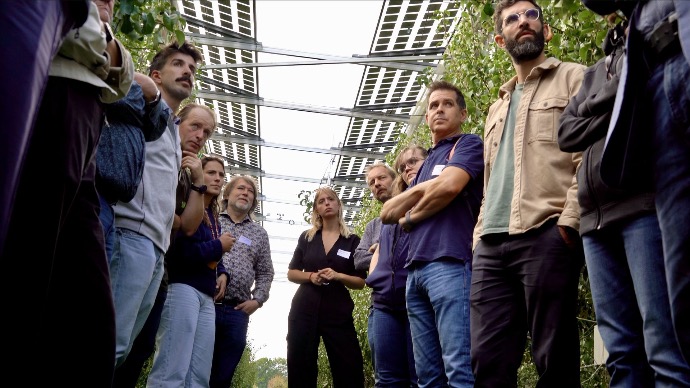
The first visit took participants to Fruit Farm Van der Velpen,
where solar panels have been installed above a pear orchard.
Developed in collaboration with KU Leuven, the installation demonstrates
how agricultural production and renewable electricity generation
can share the same land. The electricity produced can be used directly
by the farm’s cooling installation.
Water management was another important part of the visit.
The farm collects drainage water and rainwater in a reservoir for reuse in frost protection, drip irrigation and fruit cooling. This circular approach helps
the farm manage both wet and dry periods.
The visit also opened a discussion on energy communities and local cooperation. Participants explored how locally produced renewable electricity
can be shared with citizens, broadening the conversation from energy production
on individual farms to cooperation within the surrounding community.
Connecting research and farming practice
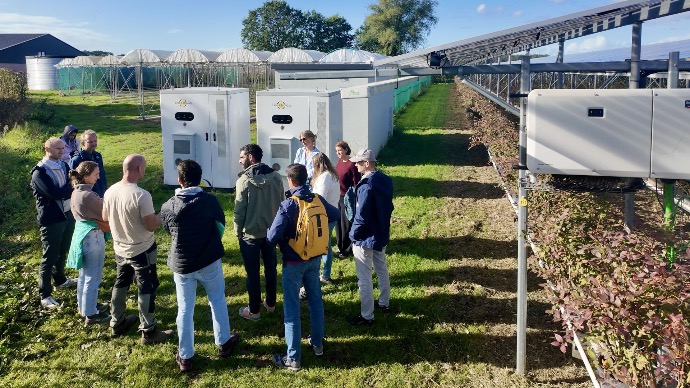
At TRANSfarm, KU Leuven’s pilot farm, participants discovered how researchers,
farmers, students and businesses work together to test and demonstrate innovative agricultural technologies.
The group visited agrivoltaic installations above arable crops and learned about research into their effects on crop growth, farm management and land-use efficiency. These field trials help connect scientific knowledge with practical questions about combining food and energy production. .
More than electricity generation
On the second day, the group travelled
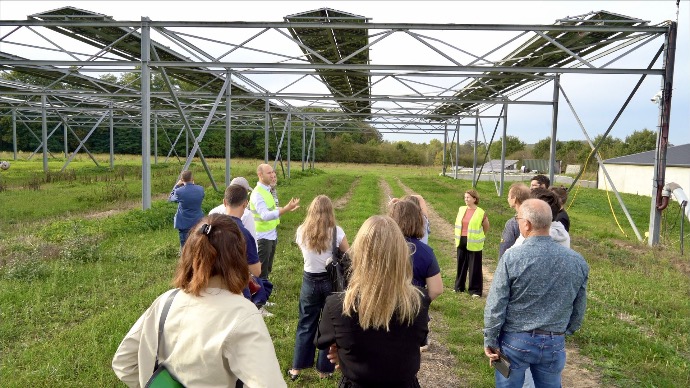
to Halberry in Hoogstraten, where Tom Mertens grows blueberries beneath
semi-transparent solar panels.
The installation illustrates how agrivoltaics can serve several purposes. Alongside renewable energy generation, the project pays attention to rainwater and drainage recovery, crop protection, biodiversity, natural ventilation and working conditions. It offered participants
a concrete example of how an agrivoltaic system can be designed around
the needs of the crop and the people working with it.
Local energy cooperation was also central to the visit. Participants were introduced to Halnet, an energy cooperative co-founded by Tom Mertens that brings farmers and citizens together around renewable energy projects. By connecting local electricity production and consumption, the initiative demonstrates how cooperation can create value and strengthen links between farms and their communities.
Learning from practice and from each other
The value of the cross-visit went beyond the individual sites. With participants from
seven countries, the programme created opportunities to compare approaches, exchange experiences and discuss common challenges surrounding agrivoltaics
and energy communities.
The Belgian examples became starting points for wider conversations. Participants could reflect on what they had seen, relate it to conditions in their own countries and explore which ideas might be relevant at home.
After two days of visits and exchange, one message stood out: the energy transition in agriculture is not just about technology. It is also about cooperation, sharing knowledge and learning across borders.