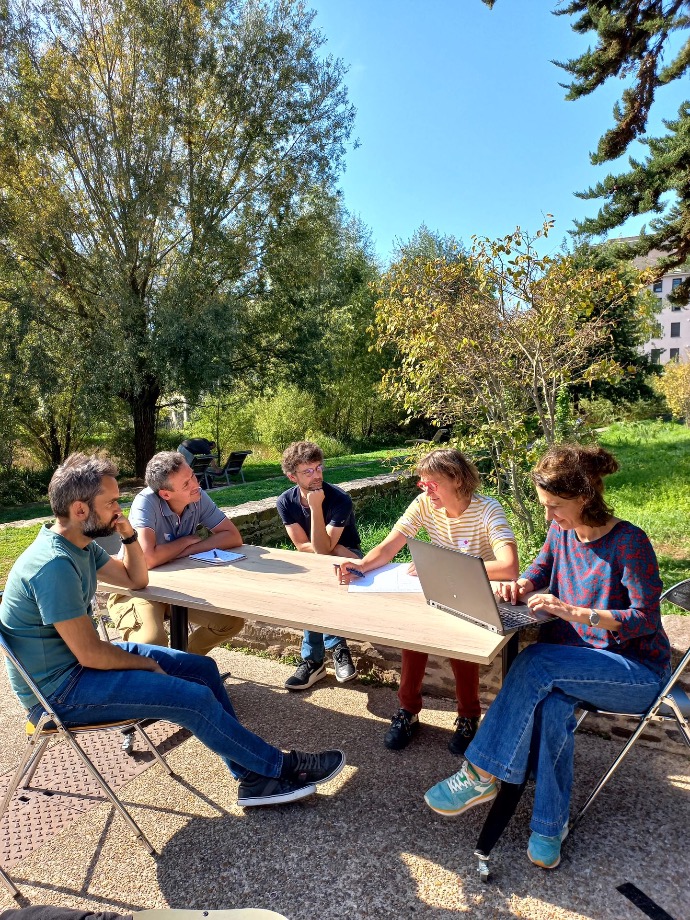
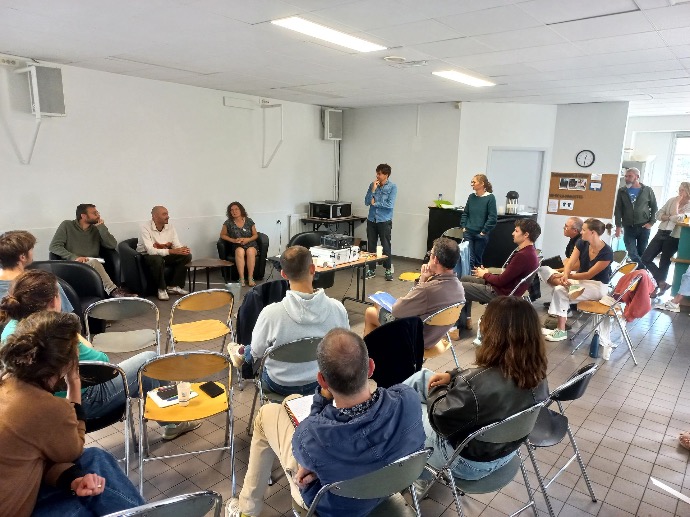
When 30 supporters of citizen energy networks gathered in Rennes on 5 and 6 October, the goal was clear: equip them to use and share the CIRCUS methodology within their own communities. It was the first time members of the Taranis network (Brittany) and the Récit network (Pays de la Loire) had been brought together for a full two-day training, and the session was designed as a transfer of practice by encouraging as much interaction as possible between participants.
Organisers (Taranis, Récit and EPV) noted that participants’ recruitment was straightforward. Taranis network regularly schedule training sessions at this time of year, so the call went out to an audience already primed for professional development, it was just needed to invite the members of the Récit network, who were happy to come along. The result: 18 supporters from Brittany and 12 from Pays de la Loire, filling the room without difficulty. The choice of Rennes as venue was pragmatic : a central location with strong transport links for both regions.
One methodology in the spotlight, three in comparison
The first day was built around
a comparative framework. The CIRCUS methodology was presented alongside three other emergence methods, giving participants the material to analyse, compare, and identify the similarities, differences and strengths of each method.
Some time was spent on a detailed presentation of the CIRCUS tools.
Participants noted CIRCUS’s innovative approach, which offers tools that make
it easy to initiate discussion within
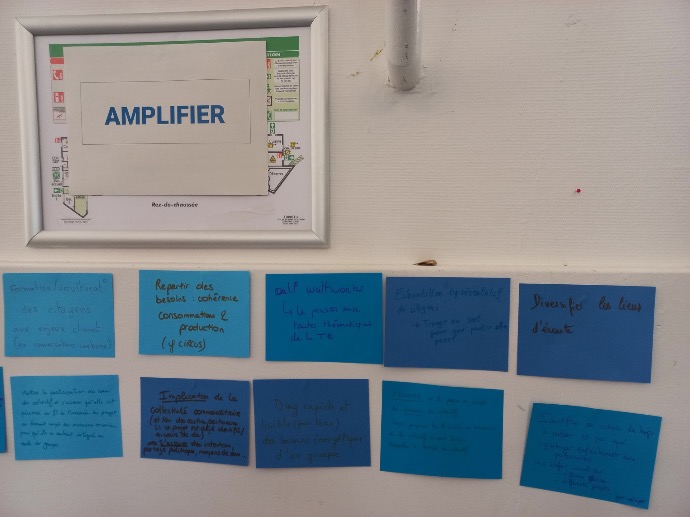
an emerging community and to build it from scratch. Theoretical modules on empowerment and group dynamics were provided the second day with a group exercise on ways to improve the emergence method so that it meets the current needs of energy communities.
What could be improved
The single most consistent theme in participant feedback was the quality of the exchanges. The heterogeneity of the group (both novices and those with more experience in supporting energy communities, different regions, different project contexts ) turned out to be an asset rather than a barrier.
This enriched the discussions amongst the participants.
One supporter summarised the experience: "It was a challenge to present three emergence methodologies and manage to extract the essence, with a fairly heterogeneous audience. I take away insights on existing tools, enriching feedback, and a confrontation of viewpoints and approaches."
Another highlighted the format: "The content was very rich. Discoveries with the CIRCUS and Récit methodologies, and animations that enabled a lot of group and plenary exchanges."
What could be improved
Several participants wished they had been able to spend more time analysing the methods through concrete case studies and worked examples of energy communities who already used the CIRCUS method. One pointed out that "analysing methodologies is always complex because we don't have time to go deep on the tools and their transposition into concrete situations."
For partners organising similar sessions, a comparative overview is valuable, but
the transfer of the methodology in depth, with concrete examples and practice time,
is where the real learning happens. It is therefore important to be able to offer further training sessions for those who are interested, so that they can explore each tool
in depth and become fully familiar with it.
What comes next
The session was designed as a first step, not an endpoint.
Additional meetings will be organised within both
the Taranis and Récit networks in 2027 to continue deepening
the tools and allowing participants to appropriate them in their own contexts.
The 30 supporters who attended now serve as ambassadors,
expected to use CIRCUS in new opportunities to support groups
of citizens and to involve new people in the process.
The follow-up sessions will be the moment to test whether
the methodology has truly taken root
and to adjust the approach based on what the field reveals.